

Flag football positions define how the game is played, organized, and enjoyed at every level. Unlike tackle football, flag football focuses on speed, strategy, and teamwork. Each position has a specific responsibility, making understanding roles essential for beginners, coaches, and competitive players.
The popularity of flag football has grown worldwide due to its safety and accessibility. Knowing flag football positions helps players choose roles that match their skills, improve team coordination, and better understand game flow during both casual and competitive matches.
Quick Summary
Flag football positions include quarterback, center, wide receiver, rusher, and defensive roles. Each position focuses on speed, passing, coverage, and flag pulling rather than physical contact, making the game safer and faster-paced than traditional tackle football.
History of Flag Football Positions
During the mid-20th century, flag football positions were derived from conventional American football. The game was invented to keep the excitement and strategy, but at the same time, come up with a way to prevent injuries. Early instances applied simplified roles, emphasizing mainly passing and very basic defensive coverage as opposed to using complex formations.
Gradually, organized leagues perfected flag football positions to be equal in offense and defense. The growth of specialization in the different positions made it possible for players to concentrate on agility, speed, and strategy, rather than on physical strength or taking down the opponent.
Quarterback (QB) Role in Flag Football
The quarterback is typically the most prominent player on the field and the most important defensive positions. He or she has to take charge of the plays, get the snap, and throw precise passes while dodging the defenders and shielding the flag from being pulled. Read More: Australian Rules Football vs Rugby
In flag football, quarterbacks do not have to rely heavily on their throwing arm and thus develop the styles of play mentioned above. If the leagues impose restrictions on how far the quarterbacks can run, then only those who have superior skills in the mentioned traits will be able to play this position.
Center Responsibilities in Flag Football
By snapping the ball to the quarterback, the center is pivotal in flag football positions. He frequently turns into a legal receiver after the snap, which opens up immediate passing options and puts the defensive coverage in doubt.
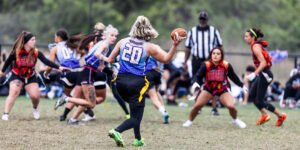
Centers should possess excellent hand-eye coordination and rapid movement, as their primary task now becomes running the routes and maintaining the offense’s flow rather than getting into physical contact because blocking is restricted.
Wide Receiver Roles and Importance
Flag football positions consist of wide receivers as the primary offensive weapons. The main task for a wide receiver is to run routes, get away from the defense, and take the ball. Fast and agile are the qualities that a player in this position needs to have to succeed.
Receivers have to be good at timing and spacing so that the quarterbacks can make fast decisions. Clear communication and route discipline help receivers to take advantage of the defenses and steadily move the ball across the field.
Key Receiver Skills:
- Quick acceleration
- Sharp route running
- Reliable catching ability
- Awareness of flag positioning
Rusher and Defensive Pressure
In the flag football positions, the rusher is a rare defensive role. The rusher is granted the right to rush the quarterback after a predetermined time or distance, and he is usually after the quarterback’s flag or trying to interfere with the passing plays.
Rushers need to be speedy and at the same time disciplined. Overly aggressive play can result in the creation of channels for passing, while on the other hand, if the rusher hesitates, it gives the quarterback extra time. The right timing and angle are essential in order to apply the pressure effectively.
Defensive Back Positions Explained
Defensive backs are tasked with shadowing the receivers and stopping the ball from being thrown to them. The defensive back position in flag football brings out the skills of waiting for the right moment, being fast, and knowing how to pull the flag rather than physical contact.
Defensive backs have to analyze the offense’s formations and come up with the right response in no time. Good communication and good positioning not only prevent big plays but also result in turnovers; thus, this position becomes crucial to the overall team defense.
Common Flag Football Positions Table
| Position | Primary Role | Key Skills |
| Quarterback | Pass execution and play control | Vision, accuracy, leadership |
| Center | Snap and short receiving routes | Coordination, agility |
| Wide Receiver | Catch passes and gain yards | Speed, route running |
| Rusher | Pressure quarterback | Speed, timing |
| Defensive Back | Coverage and flag pulling | Awareness, agility |
How Flag Football Positions Differ From Tackle Football
Flag football positions vary greatly from those in tackle football because of the rule differences and safety priority. Physical contact of blocking and tackling is taken out, and positional play, speed, and strategic flag pulling to stop plays come in as the only options left to players to be able to stop the play.
The differences between these two games make flag football not only quicker but also easier to access. People of all ages and different skills can join in and at the same time get the fun and the thrill that come with the traditional football strategy.
Final Thoughts
Understanding flag football positions helps players improve performance and enjoy the game more effectively. Each role contributes to team success through speed, coordination, and smart decision-making rather than physical force.
As flag football continues to grow globally, learning position roles and history allows players to appreciate the game’s evolution while developing skills suited for both recreational and competitive play.
FAQs
1: How many players are on the field in flag football?
Most flag football games are played with five to seven players per team on the field, depending on league rules and age groups.
2: Can players change positions in flag football?
Yes, players often rotate positions in flag football. This helps teams stay flexible and allows players to develop multiple skills.
3: Is the quarterback allowed to run in flag football?
In many leagues, quarterbacks have limited or no rushing ability. Rules vary, so it’s important to check league-specific guidelines.
4: What is the most important position in flag football?
The quarterback is often considered the most important position due to playmaking responsibilities, but team success depends on all positions working together.

[…] Flag Football Positions: Powerful Roles Every Player Must Know […]