


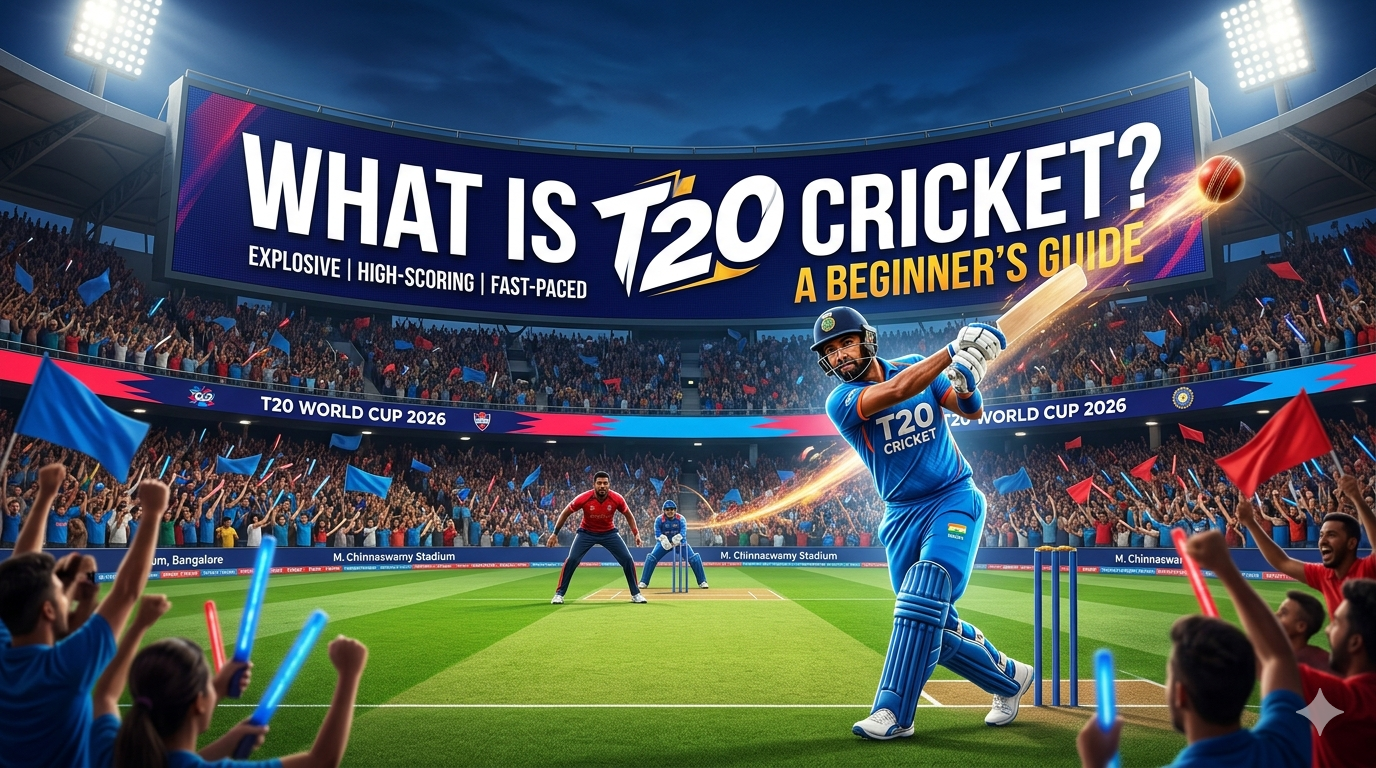
In 150+ years, Cricket has evolved to an extensive level. From having only 1 format consisting of 5 days per game to a 20-over game. In the current era, T20 cricket is a goldmine for the ICC to generate money and massive fan base. Unlike ODI and test cricket, T20 cricket is fast and action-packed format. Many franchise leagues are being played in the T20 format. The reason behind the fame of T20 cricket is the rules which made T20 cricket the most watched worldwide. Let’s check out the T20 Cricket Rules, which make this format the most loved among fans.
What is T20 Cricket?
T20 cricket is the shortest international format introduced by the ICC in 2003. T20 cricket is basically a 20-over game per innings. Where every side has 20 overs to score runs, and the opponent has the same as well to chase the target.
ICC has set the duration of a T20 game to 3 hours. This short span of time allows a couple of T20 games to happen in a day. The first-ever T20 game was played between Australia and New Zealand. To make T20 cricket more famous, the ICC introduced a World Cup in the T20 format.
The first-ever T20 World Cup was played in South Africa in 2007. After that, T20 cricket got a massive boost in fame and recognition. One of the important things that makes T20 cricket more famous is that a high score was achieved in one game. A score of 180 to 210 in a T20 innings is considered a very winning total.
Basic Rules of T20 Cricket
T20 cricket is 20 overs per innings. Every team gets 20 overs to set the target for the opposing team or chase the total. To score runs in T20 cricket, every team gets 6 overs powerplay where only 2 fielders are allowed outside the circle.
After powerplay, Bowling teams are allowed to use 5 fielders outside the 30-yard circle. That is why every team makes sure to get maximum use of the first 6 overs. But now the wickets are mostly flat, and batters score runs after 6 powerplays.
Team Composition Rules
Except for a few rules, most of the T20 cricket rules are the same as in ODI and test cricket. In a T20 game any bowler can bowl more than 4 overs. Therefore, every team adds 2 to 3 specialists and uses 1 to 2 all-rounders to get the other overs done. All-rounders help every side in T20 cricket. Allrounder is a player who can bat and bowl as well.
What is Powerplay?
Powerplay is a period of 6 overs at the start of an innings. These 6 overs are a massive plus point for batting to score massive runs. Because in these 6 overs, no more than 2 players are allowed outside the 30-yard circle. Therefore, batter only finds the gap or clears the 30-yard circle to get boundaries hit risk-free sixes as well. Therefore, in modern cricket, teams target 65-80 runs in that phase of the game. If the bowling team is able to get a couple of wickets and under 50 runs, it is considered a massive task for the bowling department.
Batting Rules in T20 Cricket
Modern T20 cricket mostly favours batters. Where most rules in T20 cricket are made to score big runs. Powerplay is a massive plus point for the batting side to score quick runs. Basic rules of cricket are that the batter will get 6 runs when they hit the ball out of the boundary line without the bounce.
If a batter is able to get through the ball that hits the boundary line with bounce, the batter will get 4 runs. To learn more about cricket rules, check out this link to basic cricket rules.
In T20 cricket, a batter’s strike rate is more important than average. Strike rate is measured by the scoring rate of the batter. If a batter hits 50 in 30 balls, the strike rate of the batter becomes 150. In modern T20 cricket, a batter is considered more valuable if he has an average of 30+ and a strike rate of 150+.
Bowling Rules in T20 Cricket
T20 cricket is challenging format for the bowlers. A single bowler cannot bowl more than 4 overs in a game. In modern-day T20 cricket, pitches are mostly flat, and rules favour batters, making T20 cricket difficult for bowlers.
So, bowlers use different techniques to make sure the batter does not score the most runs against them. In the opening overs, there is a high possibility of getting swing in T20 cricket. So the bowler finds swing in the early overs. An economy rate of 8.5 or below is considered best for a bowler.
Conclusion
T20 cricket has revolutionized the sport of cricket. Where in past the game was low scoring and more attacking by the bowler. But now the scene of cricket has been changed. Batter gets more favours from pitches to rules. T20 cricket favours batters mostly, and after 2020, there is a trend of making 220+ scores. The rules and pitches have made T20 cricket miserable for the bowler. But few bowlers have emerged as one of the top bowlers of this generation in T20 cricket.
FAQs
- What is a strike rate in T20 cricket?
Strike means how fast the batter scores runs. If a batter scores 20 runs on 10 ball his/her strike will be 200.
- Why is strike rate important in T20 matches?
Strike rates matter the most in T20 cricket because teams need quick runs. If a team has 5 to 6 batters with a 150+ strike rate, it becomes a very lethal side.
- Is there any ICC tournament for T20 Cricket?
THE ICC T20 World Cup is a global event by the ICC, which is played after every 2 years in the T20 format.
- Which tournaments lift the popularity of T20 Cricket to an extensive level?
IPL, the Indian Premier League, helped T20 cricket to become more famous than ODI and Test cricket.


