

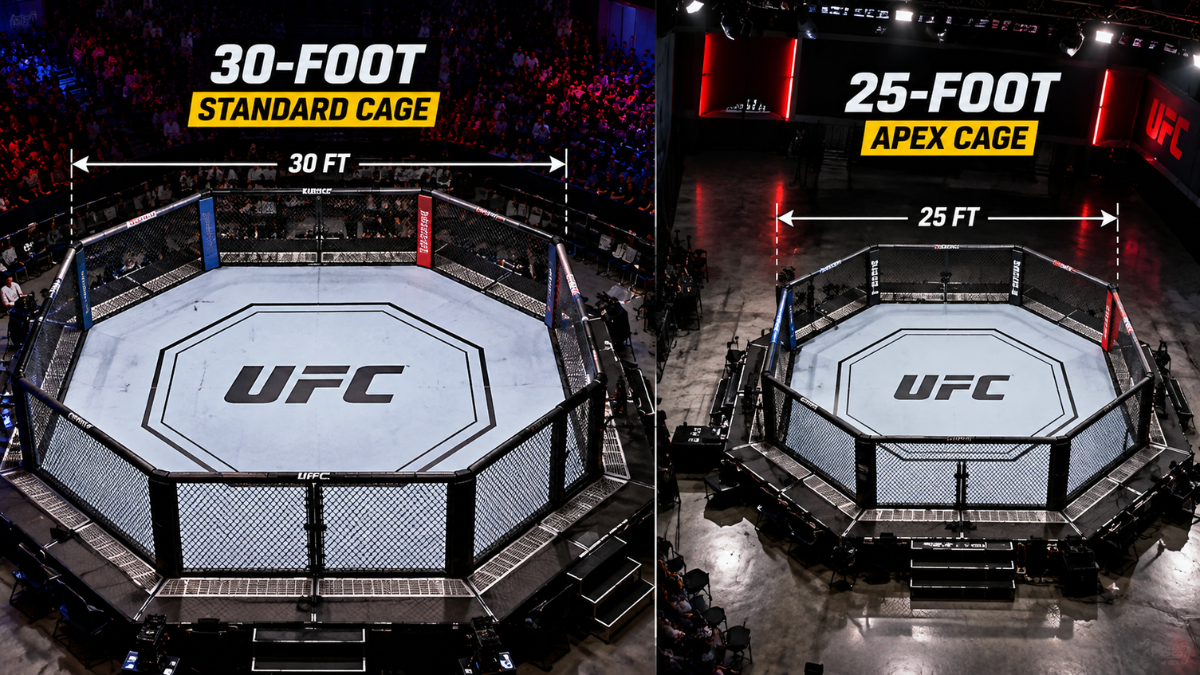
The UFC uses two different cage sizes, and the difference can change how fighters approach a matchup. The standard Octagon measures 30 feet across, while the smaller version measures 25 feet.Understanding UFC octagon cage size and dimensions helps explain why some fighters prefer more space and others benefit from fighting near the fence. Both cages share the same eight-sided design, but their fighting areas differ considerably.
UFC Octagon Size: Standard and Smaller Cage Measurements
The standard UFC Octagon measures 30 feet (9.14 meters) across its interior fighting area. The smaller version measures 25 feet (7.62 meters), giving fighters less room to move.
The standard cage provides approximately 746 square feet of fighting space. The smaller cage offers around 518 square feet, a reduction of roughly 31%. Both versions use an eight-sided structure surrounded by protective fencing.
| Measurement | Standard UFC Octagon | Smaller UFC Octagon |
| Interior width | 30 feet (9.14 m) | 25 feet (7.62 m) |
| Fighting area | Approx. 746 sq. ft. | Approx. 518 sq. ft. |
| Fighting area in square meters | Approx. 69.3 m² | Approx. 48.1 m² |
| Fence height | 5 feet 9 inches | 5 feet 9 inches |
| Platform height | 4 feet | Typically 4 feet |
| Number of sides | 8 | 8 |
| Entrance gates | 2 | 2 |
| Common use | Major arena events | APEX and selected smaller events |
The difference might appear small when comparing only the width. However, losing five feet across the cage removes more than 200 square feet of fighting space.
That reduction can influence movement, distance management and the amount of time fighters spend near the fence.
What Are the Official UFC Octagon Dimensions?
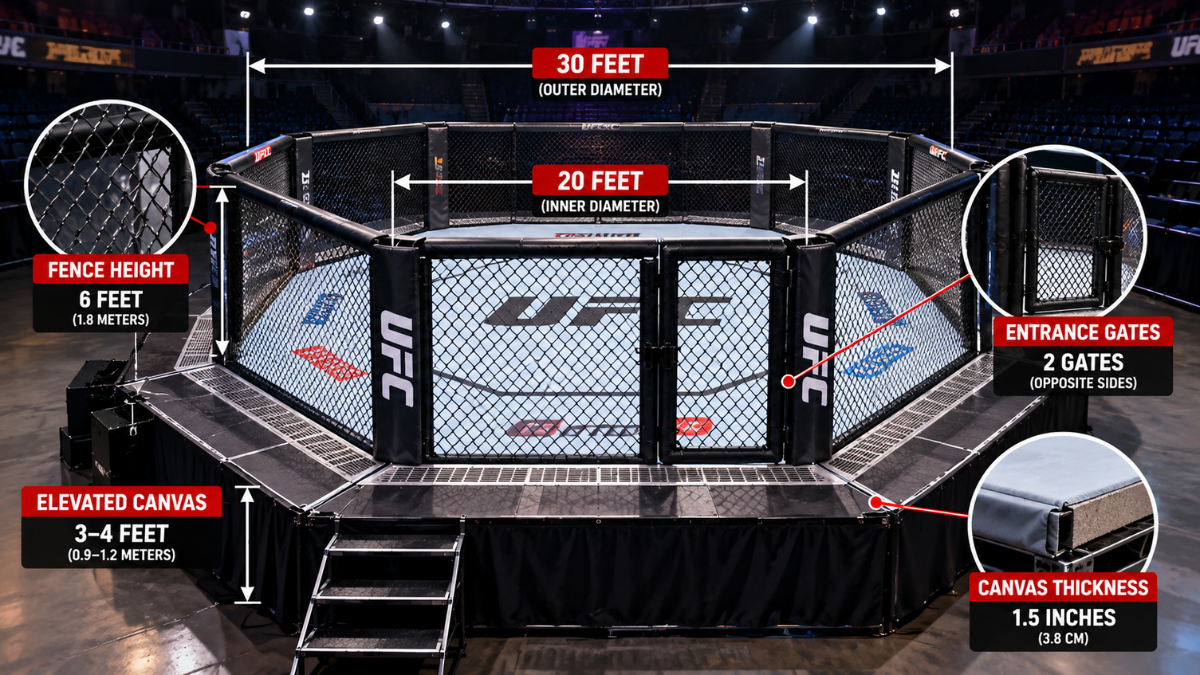
The UFC publishes detailed measurements for its standard Octagon. These specifications cover the fighting surface, exterior platform, entrance gates and protective fencing.
The standard cage measures 38 feet across its exterior platform, including the surrounding walkway. Its interior fighting space measures 30 feet across.
Standard UFC Octagon Dimensions
According to the UFC’s published specifications, the standard Octagon has the following measurements:
| Component | Official measurement |
| Exterior width | 38 feet (11.5 m) |
| Interior fighting width | 30 feet (9.1 m) |
| Surrounding walkway | 4 feet wide |
| Platform height | 4 feet (1.2 m) |
| Fence height above canvas | 5 feet 9 inches (1.75 m) |
| Number of entrance gates | 2 |
| Gate width | 3 feet (0.91 m) |
| Gate height | 5 feet (1.52 m) |
The surrounding walkway gives officials, cornermen and other authorized personnel access to the cage entrances. Fighters compete only within the enclosed fighting area.
The elevated platform also helps spectators see the action from different positions inside an arena.
How High Is the UFC Octagon Fence?
The UFC’s official specifications list the fence height at 5 feet 9 inches, measured from the canvas to the top of the fence.
The cage platform stands approximately four feet above the arena floor. Therefore, the top of the fence reaches roughly 9 feet 9 inches above ground level.
The fence prevents fighters from falling outside the competition area during takedowns, clinch exchanges and other physical contact. Protective padding covers the upper edges and vertical supports.
Why Does the UFC Use Two Different Octagon Sizes?
The UFC uses different cage sizes to accommodate various event settings. Major arena shows generally feature the standard 30-foot Octagon, while smaller productions have often used the compact version.
The smaller cage became particularly familiar to fans through events at the UFC APEX in Las Vegas. Its reduced footprint suits the venue’s production environment and creates a noticeably different fighting space.
However, the UFC does not assign cage sizes according to weight class. Heavyweights and flyweights can compete inside either version, depending on the event.
Standard 30-Foot Octagon
The standard Octagon gives fighters more room to circle, retreat and reset their positions. Strikers who depend on movement can use the additional space to maintain their preferred distance.
Wrestlers must sometimes cover more ground before initiating takedowns. Opponents also have additional room to move away from the fence before grappling exchanges develop.
That does not automatically favor one fighting style. Fighters who control distance effectively can benefit from the larger cage, regardless of whether they primarily use striking or grappling.
Smaller 25-Foot Octagon
The 25-foot cage reduces the distance between fighters and the fence. Competitors can close the gap more quickly, while opponents have less space to escape pressure.
Aggressive strikers may find it easier to force exchanges. Wrestlers can also benefit because opponents have fewer opportunities to circle away from takedown attempts.
However, the smaller cage can also help defensive grapplers reach the fence and work back to their feet. The actual advantage depends on each fighter’s skills and strategy.
How Much Bigger Is the Standard UFC Octagon?
The standard cage measures 30 feet across, making it 20% wider than the 25-foot version.
Its fighting area is approximately 746 square feet, compared with 518 square feet in the smaller cage. That makes the standard Octagon roughly 44% larger in total fighting area.
<text> </text>
| Size comparison | Difference |
| Interior width | 5 feet |
| Width increase | 20% |
| Fighting area | 228 sq. ft. |
| Area increase | Approximately 44% |
| Smaller cage’s area reduction | Approximately 31% |
These percentages describe the same difference from different starting points. The standard cage has about 44% more area than the smaller one, while the smaller cage has about 31% less area than the standard one.
The difference becomes important when fighters need space to recover, escape pressure or establish their preferred striking range.
Does UFC Octagon Size Affect Fight Outcomes?
Cage size can influence how a fight develops, although it cannot determine the winner by itself. The smaller Octagon generally gives competitors less room to disengage.
A fighter who constantly moves backward may reach the fence sooner. Meanwhile, an opponent applying pressure can force exchanges without covering as much distance.
However, skill, conditioning, preparation and tactical adjustments remain more important than cage dimensions alone.
Does the Smaller UFC Cage Produce More Knockouts?
The smaller cage can encourage more frequent exchanges because fighters have less space to avoid contact. That may create additional opportunities for knockouts and technical knockouts.
Historical comparisons have reported higher finishing rates in the smaller Octagon. However, those figures depend on the events and periods studied, and they should not be treated as a permanent rule.
Fight outcomes also depend on matchmaking, fighter experience and the styles involved. A smaller cage does not guarantee a knockout or submission.
Does a Larger Cage Favor Strikers?
A larger cage can benefit strikers who rely on footwork, range management and counterattacks. They have more space to circle away from opponents who constantly move forward.
However, not every striker prefers distance. Pressure fighters who enjoy exchanging punches at close range may feel more comfortable in the smaller Octagon.
The distinction becomes clearer when examining different MMA fighting styles and how athletes combine striking, wrestling and grappling.
Why Is the UFC Cage Shaped Like an Octagon?
The UFC introduced its eight-sided fighting area at UFC 1 in November 1993. The design helped distinguish the new promotion from traditional boxing and kickboxing competitions.
An eight-sided cage also provides a continuous enclosed boundary. Fighters can move around the perimeter without encountering the sharp 90-degree corners found in a square ring.
The design quickly became one of the UFC’s most recognizable features. The promotion later established trademark protections around the Octagon name and its distinctive presentation.
Why Doesn’t the UFC Use a Boxing Ring?
A traditional boxing ring uses ropes to mark the competition area. Those ropes work well for boxing but present different challenges when fighters attempt takedowns and ground grappling.
MMA athletes frequently wrestle against the boundary and use it to defend takedowns or return to standing positions. A fenced enclosure provides a more consistent barrier for those exchanges.
The cage also reduces the possibility of fighters falling through ropes during scrambles. Its design supports the combination of striking and grappling techniques permitted under MMA rules.
What Is the UFC Octagon Cage Made Of?
The UFC Octagon combines a metal framework, protective fencing, a supported floor and a textured canvas surface. Each component serves a specific purpose during competition.
The fence uses metal chain-link material with a protective coating. Padding covers exposed structural areas to reduce the risk of injury when fighters collide with the boundary.
UFC Octagon Floor and Canvas
The fighting surface includes a rigid supporting structure with cushioning beneath the canvas. This construction provides stability for movement while offering some impact protection during takedowns.
The UFC describes its canvas as textured and hand-painted. The promotion uses a fresh canvas for each event.
The texture helps fighters maintain traction during striking exchanges, wrestling and positional changes. However, sweat and other moisture can still affect footing during a contest.
UFC Octagon Fence and Padding
The fence allows fighters to lean against the boundary during clinch exchanges. It also gives grapplers a surface they can use when attempting to stand.
Protective padding covers the top of the fence and its vertical supports. The UFC uses these features to reduce direct contact with harder structural components.
The cage has two entrance gates on opposite sides. Officials control access before, during and after each fight.
How Does Cage Size Affect Wrestling and Grappling?
Wrestling often involves driving an opponent toward the fence before attempting a takedown. The smaller Octagon reduces the distance needed to establish that position.
Once a fighter reaches the fence, both competitors can use it strategically. The attacking wrestler may apply pressure, while the defending fighter can work toward a standing position.
The larger Octagon provides more room for lateral movement. However, experienced wrestlers can still control distance and force opponents toward the boundary through effective footwork.
Does the Smaller Cage Favor Wrestlers?
It can favor wrestlers who excel at pressure and cage control. Opponents have less room to circle away, potentially creating more opportunities to initiate grappling exchanges.
However, successful wrestling depends on timing, technique and physical conditioning. A smaller cage does not automatically overcome poor takedown entries or weak positional control.
Defensive wrestlers may also benefit from reaching the fence sooner. The cage provides opportunities to build a base and escape from certain ground positions.
How Does Cage Size Affect Striking and Footwork?
Strikers use distance to create openings and avoid incoming attacks. The standard Octagon offers additional room for movement, particularly during exchanges involving kicks and long-range punches.
The smaller cage can make it harder to retreat without reaching the fence. Fighters who rely heavily on circling must manage their positioning more carefully.
Pressure strikers may benefit from the reduced space because they can close distance faster. Counterstrikers, meanwhile, must rely on timing and angles rather than simply moving backward.
These differences explain why analysts consider cage dimensions when evaluating certain UFC matchups.
Are UFC Octagon Dimensions the Same in Every Weight Class?
The UFC does not use separate cage dimensions for each weight division. The event determines which Octagon configuration fighters use.
A flyweight contest can take place in the same cage as a heavyweight matchup. The rules governing weight limits remain separate from the physical dimensions of the fighting area.
Readers unfamiliar with the divisions can review the UFC weight classes to understand how the promotion organizes fighters.
Although cage size remains consistent throughout an event, different weight classes may produce different styles of competition. Heavier fighters often bring greater individual punching power, while lighter divisions frequently feature faster exchanges.
Can Fighters Use the UFC Cage During a Fight?
Yes. Fighters regularly use the fence during legal wrestling, clinch and defensive exchanges.
A competitor may press an opponent against the cage, use it to maintain balance or work back to a standing position. These techniques form an important part of modern MMA.
However, fighters cannot grab or hold the fence with their fingers to gain an unfair advantage. Referees can intervene when an athlete violates the rules.
The distinction matters because using the fence for positioning is different from illegally gripping it to prevent a takedown.
Has the UFC Octagon Changed Since 1993?
The UFC introduced the Octagon during its first event in 1993. The eight-sided concept became a defining feature of the promotion as MMA developed into a regulated professional sport.
Over time, the UFC refined its cage construction, padding and presentation. The promotion also adopted different cage sizes for various event environments.
The basic design remains recognizable. Fighters still compete inside an enclosed eight-sided structure, with officials controlling the entrances and enforcing the rules.
The Octagon’s development forms an important part of the broader history of the UFC.
Final Thoughts
The standard UFC Octagon measures 30 feet across and provides approximately 746 square feet of fighting space. The smaller version measures 25 feet across, offering roughly 518 square feet.
Understanding UFC octagon cage size and dimensions reveals why the difference matters. The larger cage offers more room for movement, while the smaller one brings fighters closer to the fence and can encourage more frequent exchanges.
Neither configuration guarantees a particular result. Fighters still need the right skills, conditioning and strategy to take advantage of the available space.
FAQs
What is the official UFC octagon size?
The standard UFC Octagon measures 30 feet (9.14 meters) across its interior fighting area. A smaller 25-foot version also exists.
How many square feet is the UFC Octagon?
The standard UFC Octagon provides approximately 746 square feet of fighting space. The smaller version offers around 518 square feet.
How tall is the UFC Octagon cage?
The official fence height is 5 feet 9 inches above the canvas. The platform itself stands approximately four feet above ground level.
Why is the UFC APEX cage smaller?
The UFC has used a smaller 25-foot Octagon at APEX events. Its reduced size suits the compact event environment and gives fighters less room to move.
Does UFC cage size affect fight results?
Cage size can influence movement, pressure, takedowns and striking exchanges. However, it does not determine the winner or guarantee a particular type of finish.