


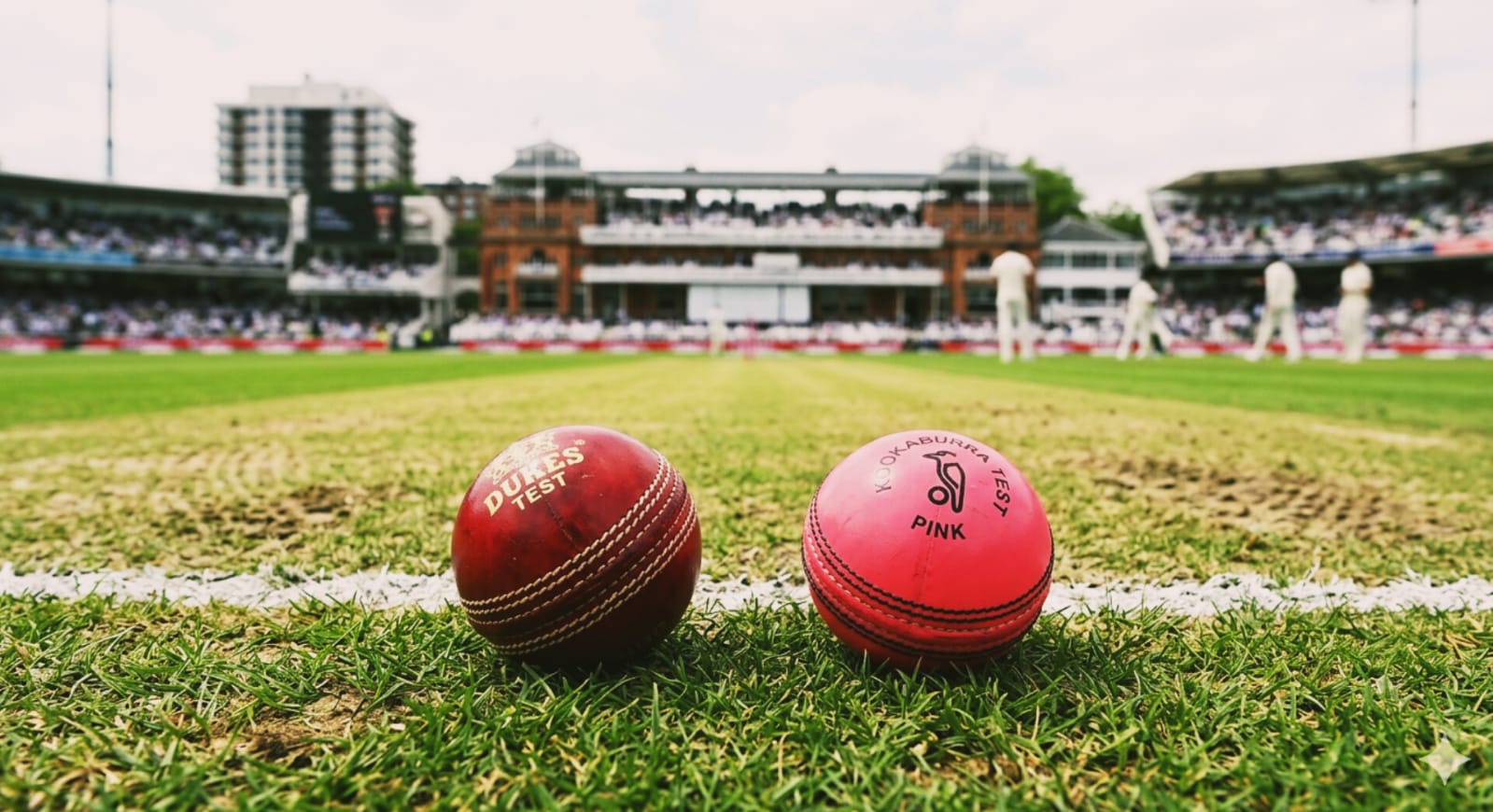
The Test cricket ball shapes how a match develops across five days. A new ball helps fast bowlers produce swing and seam movement, which makes the start of an innings difficult for batters. As the ball gets older and softer, scoring becomes easier and teams change their plans. Most Test matches use the traditional red ball because it is easier to see in daylight. In day-night Tests, a pink ball is used so players can see it clearly under floodlights.
What Is a Test Cricket Ball?
A test cricket ball is a hard leather ball. The ball is used in the longest format of international cricket. It is specifically designed to withstand up to 80 overs before it is replaced with another ball. Red balls are used in test cricket for better visibility during daylight matches.
The center of the ball is composed of compressed cork to provide hardness and bounce. Layers of tightly wound strings are wrapped around the cork. It provides durability and shape to the ball. The outer surface of the ball is composed of four layers of dyed leather. Six rows of stitching create the seam. It allows the generation of seam movement and swing in the air.
Types of Test Cricket Balls Used Around the World
Different cricket boards use different ball manufacturers depending on the country in which they play.
- The Duke’s ball is used in England and the West Indies. They have a hand-stitched seam and offer more swings to fast bowlers.
- The Kookaburra ball is used in Australia, New Zealand, South Africa, and Pakistan. It has a flatter seam and offers fewer swings in the initial overs.
- The Sanspareils Greenland (SG) ball is used in India. It has a prominent seam and hard leather.
Red Ball in Test Cricket
Red balls are used in traditional test cricket. It is because they have greater visibility during daylight. They retain their shapes longer than 90 overs. Red balls allow a balance between batters and bowlers. Red balls swing longer and retain their shine. Red balls are polished, which makes them durable.
Pink Ball in Test Cricket
The pink ball is a special ball used in day/night cricket matches. It allows matches to be played under artificial lights in the evening. The pink ball is similar in size and weighs as much as the red ball. They have extra lacquer coating to maintain their shine longer than red balls.
Test Cricket Ball Weight and Official ICC Specifications
The weight of test cricket balls affects the overall performance of the match, from bowling speed to batting timings. International Standards regulate the weight of a test cricket ball. According to official regulations, the weight of the ball is between 155.90 g and 163.01g. A cricket ball should have a diameter of 7.11_7.26 cm. The circumference of the ball must be 22.4-22.9cm.
The International Cricket Council ensures consistency across all international matches by maintaining regulations. Maximum 1% variation is acceptable. Professional matches use balls that undergo testing and certification processes. Training is provided for umpires on ball inspection. This approach ensures that each cricket ball meets the standards.
New Ball in Test Cricket: Rules and Strategy
A new ball is a freshly used ball in test cricket. It is hard, fresh, and shiny. According to the rules of the International Cricket Council, each inning starts with a new ball. The captain of the fielding team is offered a new ball after 80 overs.
If the inning continues beyond 80 overs, the captain may choose to play with the old ball or get a new one. The shiny surface of the new ball allows better swing. The pronounced seam helps the ball move off the pitch. Many teams use their fast bowlers to dismiss the top order quickly.
Differences Between Red Ball and Pink Ball in Test Cricket
In test cricket, both red and pink balls are used in different conditions. The red ball is dark red in color and is used during daylight matches. Pink balls have a bright pink color and are used during day/night matches. It provides better visibility in floodlights.
Red balls offer more swings early in an inning and gradually become softer. The pink ball swings more under the light, making batting challenging. Test Cricket balls are made of cork mixed with rubber and outer layer with leather. The red ball shines naturally. An extra layer of lacquer is added to the pink ball to maintain shine. The red ball gets softer as the match progresses, while the pink ball remains hard.
Fastest Ball in Test Cricket History
The fastest ball bowled in test cricket history was by Mitchell Starc. Mitchell Starc is one of the fastest left-arm bowlers in modern cricket. He delivered a ball at 160.4 km/h during a test match between Australia and New Zealand.
Who Faced the Most Balls in Test Cricket?
The player who faced the most balls in test cricket is Rahul Dravid (31,258). He is an Indian cricketer who has played international cricket for 24 years. Facing the most balls in test cricket means incredible patience and consistency. Some other legendary batters who have faced high balls include Jacques Kallis and Rahul Dravid.
Final Thoughts on the Test Cricket Ball
The Test cricket ball influences every phase of a Test match. Its weight, shine, and condition affect both bowling and batting. Bowlers use the new ball to attack early wickets, while batters try to settle once the ball becomes softer. Teams also decide when to take the new ball to regain momentum. Whether it is the red ball used in traditional matches or the pink ball used in day-night Tests, the ball plays a major role in how the longest format of cricket unfolds.
FAQs
Which ball is used in Test cricket?
Test cricket traditionally uses the red ball for daytime matches. In day-night Test matches, a pink ball is used to improve visibility under floodlights.
What is the weight of a Test cricket ball?
According to official regulations, a Test cricket ball weighs between 155.9 grams and 163 grams.
Why is the red ball used in Test cricket?
The red ball is used because it provides better visibility in daylight and maintains its shape and shine longer during long matches.
Why is the pink ball used in Test cricket?
The pink ball is used in day-night Test matches because it is easier to see under artificial lights and maintains visibility for players and spectators.
When is the new ball taken in Test cricket?
A new ball is available after 80 overs in Test cricket. The fielding captain can decide whether to take the new ball or continue with the old one.
Who faced the most balls in Test cricket?
The player who faced the most balls in Test cricket is Rahul Dravid, with 31,258 deliveries during his international career.
What is the fastest ball in Test cricket?
The fastest ball in Test cricket was recorded at 160.4 km/h, bowled by Mitchell Starc during a Test match between Australia and New Zealand.


