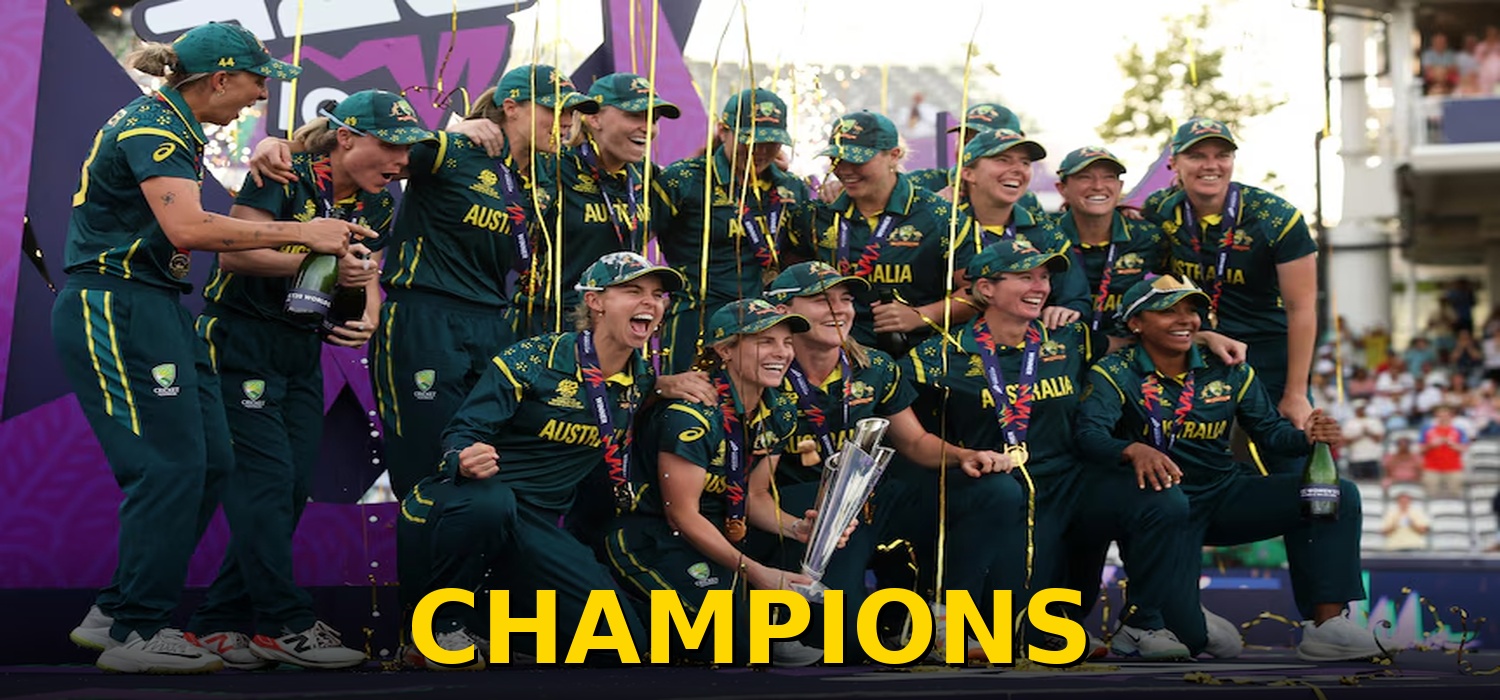
Australia Win Their Seventh Women’s T20 World Cup. They beat England by seven wickets in the final at Lord’s Cricket Ground in London on July 5, 2026. Chasing 151, Beth Mooney and Phoebe Litchfield put on a partnership that made the chase look easy. Australia won with 17 balls remaining. It was clinical, dominant, and entirely expected from the greatest team in the tournament’s history.
England’s Innings: Sciver-Brunt and Kemp Rescue the Total
England won the toss and chose to bat first. It was not the start they needed. Danni Wyatt-Hodge was dismissed cheaply for 11. Australia had reviewed a not-out decision and it was upheld. The tournament’s top run-scorer was gone in the powerplay. England were 39 for 2 after six overs. The pressure was already building at Lord’s.
Nat Sciver-Brunt and Alice Capsey steadied the innings briefly. But Sophie Molineux castled Capsey for 16 with a direct delivery as she attempted a reverse sweep. England were 68 for 3 at the halfway stage. Something special was needed.
A Partnership That Gave England Hope
Sciver-Brunt and Freya Kemp delivered exactly that. The pair put on 80 runs off 55 balls for the fifth wicket. It was a partnership built on smart running, well-placed boundaries, and genuine composure under pressure. Kemp was particularly eye-catching, scoring 44 off just 28 balls with five boundaries.
England finished with 150 for 4 in their 20 overs. Sciver-Brunt was unbeaten on 58 off 53 balls, her second consecutive half-century in the knockout rounds. The last over went for 13 runs. England had pulled themselves to a fighting total, but whether 150 was enough against this Australian batting lineup was always the real question.
Australia’s Powerplay: Georgia Voll Falls But the Damage Is Done
Australia lost Georgia Voll cheaply to Lauren Bell in the second over, clean bowled for a low score as Lord’s briefly erupted. But Bell had given away extras before that wicket, and Voll’s departure meant little in terms of momentum. Australia reached 62 for 1 at the end of the powerplay. It was one of the most explosive powerplay performances in a Women’s T20 World Cup final. The match was effectively over before the halfway stage.
Sophie Ecclestone was England’s main bowling hope. She finished with 0 for 24 from her 3.1 overs, a wicketless but economical spell that kept some pressure on the scoring rate. Ultimately, it was not enough. Eight extras, including wides from various bowlers, added unnecessary pressure on England’s total. The five wides conceded by Ecclestone in one spell became a talking point, handing Australia additional deliveries at a critical stage of the chase.
Mooney and Litchfield Take the Trophy
Beth Mooney and Phoebe Litchfield took charge from the first over after Voll’s dismissal. Mooney was in sublime touch. She hit five fours in the powerplay alone, batting with the controlled aggression that has defined her knockout match performances across multiple World Cups. She averages 72.00 in T20 World Cup knockout matches, a number that belongs in a completely different bracket to almost every other batter in the game.
Litchfield was equally impressive. She aced the switch hit, drilled straight drives, and swept with precision. She hit the first six of the chase in the fifth over and never looked back. The pair reached their fifty partnership in just 29 balls. At 98 for 1 after 10 overs, Australia needed 53 runs from 60 balls. The match was done.
The Moment That Sealed It
Litchfield was eventually dismissed for 46 off an unconfirmed number of deliveries as England finally got the breakthrough they needed in the middle overs. But Mooney was still there. She brought up her half-century in 38 balls, equalling Nat Sciver-Brunt’s record of nine T20 World Cup fifties in the same match.
Ellyse Perry came in and finished the job alongside her. Australia crossed the line in the 17th over, winning by seven wickets with 17 balls remaining. The chase was complete. The trophy was theirs.
A Seventh Title and a Place in History
Australia have now won seven Women’s T20 World Cup titles. No team in cricket history, men’s or women’s, has won a global T20 event more times. They went through this entire 2026 tournament without losing a single match. They won all six group stage games. They beat West Indies by eight wickets in the semi-final. They beat England by seven wickets in the final. Not once did any opponent come close to beating them.
This was also a special moment for captain Sophie Molineux. She led Australia in her first T20 World Cup as captain and delivered the title in the most emphatic fashion possible. Her bowling, leadership, and composure throughout the tournament set the tone for a side that never looked like losing.
This tournament, played across England from June 12 to July 5, was the most watched Women’s T20 World Cup in history, and Australia’s campaign was its defining story from start to finish. Our complete guide to the Women’s T20 World Cup 2026 schedule and contenders covers how this historic tournament unfolded from its opening night at Edgbaston all the way to this Lord’s final.
What This Means for England
England will feel the pain of this defeat for some time. They hosted a World Cup. They went through the group stage unbeaten. They had the home crowd. They had Wyatt-Hodge and Sciver-Brunt. They had every reason to believe this was their moment. It was not enough.
Australia have now beaten England in three Women’s T20 World Cup finals, in 2012, 2018, and now 2026. England’s only final win against Australia came 17 years ago in 2009, the inaugural edition at the same Lord’s ground.
The historical weight of this rivalry sits heavily on England, and Sciver-Brunt’s side will have to regroup and rethink before the next major tournament cycle begins. For more context on how this Australia side dismantled every opponent across the tournament, including their semi-final demolition of West Indies, our earlier coverage of the Australia Women vs South Africa Women group stage match showed exactly how early in this competition their dominance was established.
Conclusion
Australia are the greatest team in women’s T20 cricket history. Seven titles say everything. This Lord’s final was their masterclass. England fought hard but Mooney and Litchfield were simply too good on the day. Sophie Molineux lifts the trophy at Lord’s in her first World Cup as captain. Australia go home as champions. England go home wondering what more they could have done.


