


Why doesn’t football make the goal bigger to increase scoring? Or smaller to make defending easier? The answer lies in how deeply the goal’s dimensions shape the entire game. The fixed width and height of a football goal influence tactics, shooting decisions, defensive structure, and even goalkeeper selection.
Every pass, cross, and shot is calculated around that space. A simple frame of posts and a crossbar is actually the centre of strategy in modern football. To understand how the game truly works, you need to understand how goal dimensions affect it.
What Are the Standard Dimensions of a Goal in Football?
A football goal can vary in size depending on the level of play. However, the standard goal size is 7.32 meters wide and 2.44 meters high. These measurements are taken from the inside edge of one goalpost to the other and from the ground to the underside of the crossbar. The width and depth of the crossbar and post must be identical, with a maximum of 12cm.
Dimensions of a Goal in Football by Category and Age Group
Goal dimensions vary by age group and match category. Choosing the right goal dimensions is important for fair play, safety, and player development. Professional goal sizes are standard, while youth and training goal sizes vary by country and competition.
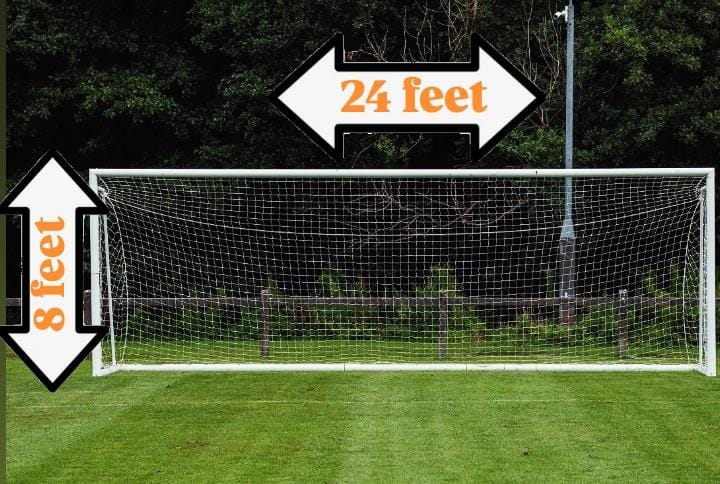
Commonly used dimensions in professional matches are 24ft wide x 8ft high. These dimensions are used in outdoor matches by players aged 15 or older. Meanwhile, youth under 11 or 12 use a goal size 16ft wide x 7ft high. The basic rules of soccer define all the goal post sizes. Mini-Soccer (5v5 and 7v7) is recommended to be 16ft wide by 4 ft high. Futsal goal posts should measure 9.8ft wide x 6.6ft high.
Tactical Impact: How Goal Size Shapes the Modern Game
The size of the football goal remained the same at the professional level for many years, yet it shapes how the modern game is played. The unchanged dimensions of the football goal help teams become more creative, faster, and more tactical.
The Geometry of Shooting Angles
The 24-foot width of the goal shapes the modern game of football. Modern teams focus on creating better shooting angles as the goal size remains unchanged. They try to shoot from the places that work in their favour, rather than shoot more. The team throws balls to create one-on-one chances and allows quick passing to move the goalkeeper out of position.
Defensive Positioning and the Goal Mouth
In today’s football, defending is all about controlling space in front of the Goal Mouth to reduce the chances of a goal. Goal Mouth is the area in front of the goal that attackers see when shooting. Defenders and goalkeepers work together to reduce the visible width of the goal, block shooting lanes, and force shots from poor angles. The best defences do not stop shots, but they shape where shots come from, reducing the chance.
The Goalkeeper’s Challenge: Covering 17.86 Square Meters
Modern goalkeeping is one of the toughest jobs in football. The goalkeeper has to cover the same width as the goal, since the goal has not changed in size, but everything else has. The players become smarter by using quicker shots, making their attacks more structured. Modern goalkeepers win games not just through reflexes but also through positioning.
Angle Play and Surface Area
Goalkeepers are now trained to assume an initial position and cover the entire shooting area. They can stay tall to cover the top corners, as the goal is 24 feet wide. A single step forward or sideways can increase the chance of a goal as the shooter can visualize the goal mouth.
Physicality vs. Goal Dimensions
The height of the crossbars remains consistent at 8 feet to make the game fair. This fixed dimension helps select and train the goalkeeper. For a goalkeeper, height is a great advantage as it allows them to cover the top corner, which is the hardest part of the goal to defend.
Taller goalkeepers also have long arms to cover more vertical surface. It allows them to save more shots with their expanded reach. The fixed height of the crossbar does not force the goalkeeper to grow taller, but it does favor taller goalkeepers. Hence, both physicality and goal dimensions complement each other.
Why the Dimensions of a Goal in Football Rarely Change
Football authorities rarely change the dimensions of the football goal. But the game has evolved as players are faster and smarter, which raises this question again and again. The dimensions of the football goal are stable and are necessary for fairness and maintaining consistent tactical balance.
Any change in goal dimensions can reduce a goalkeeper’s performance over time and the team’s goal-scoring records, and can also cause tactical imbalance. It also increases the risk of injury, as goalkeepers are trained for the current dimensions. Changing goal size means modifying or replacing stadiums and training grounds, which is very costly.
Conclusion
The dimensions of a football goal may seem simple, but they play a major role in shaping the modern game. A fixed width and height create a balance between attackers and defenders. They influence shooting angles, defensive setups, and goalkeeper training. Even though the sport continues to evolve, the goal size remains stable to protect fairness and consistency. By maintaining the same dimensions, football preserves its competitive balance while allowing tactics and athletic performance to evolve around it.
FAQs
Are all football goals the same size?
No. Professional outdoor football fields are standard 7.32 meters wide and 2.44 meters high. Youth, mini-soccer, and futsal use smaller goal sizes based on age group and competition level.
How deep should a football goal net be?
There is no strict universal rule for net depth, but it is usually between 1.5 and 2 meters at the bottom. The net must allow enough space to show when a goal is scored clearly.
Why is a football goal 8 feet high?
The 8-foot height provides a fair balance between scoring and goalkeeping. It allows exciting attacking play while still challenging goalkeepers to defend effectively.
Why are goal dimensions fixed?
Goal dimensions remain fixed to maintain fairness and historical consistency in the game. Changing the size would affect tactics, records, player training, and stadium design.
How do goalkeepers cover angles?
Goalkeepers reduce shooting angles by adjusting their position in relation to the ball. By stepping forward and staying aligned with the shooter, they make the visible goal area smaller and increase their chances of making a save.


